Employee surveys give organizations access to large amounts of valuable information. For example, we can measure engagement, leadership, the work environment, and well-being, and track how employees’ experiences change over time.
But the real challenge often begins once the results are in.
What should we actually do with all this data?
For many managers, employee survey results mean yet another set of information to consider in an already busy schedule. The results may highlight several areas for improvement at the same time, comments may add further perspectives, and changes over time need to be understood.
So the challenge is rarely a lack of data.
The challenge is turning insight into action.
And this is where AI can change the game.
From reports to understanding
Traditionally, managers have had to interpret the results themselves. What has changed? What stands out? What should we prioritize? And above all – what do we do now?
AI creates new opportunities to make this process both easier and faster. By analyzing employee data, AI can help identify patterns, summarize information, and highlight areas that may be important to explore further.
Instead of simply being presented with yet another report, managers can get help answering questions such as:
- What matters most in my results?
- What has changed since previous surveys?
- Which areas do we need to understand better?
- What should I discuss with my team?
- How can we move forward from here?
This represents an important shift from “Here are your results” to “Here’s what the results could mean – and how you can take the next step.”
When AI becomes a manager’s sounding board
This is also part of the thinking behind Puls+ AI.
Rather than AI becoming yet another tool managers need to learn, the opportunity lies in making the information that already exists more useful. Imagine a manager who has just received the results of an employee survey. Instead of trying to interpret the numbers alone and determine what matters most, the manager can use AI as a sounding board to explore the results.
They might ask questions such as:
“What stands out in my team’s results?”
“Which areas should I prioritize?”
“How can I talk to my team about this?”
“What could be a good next step?”
Here, AI does not replace the manager. Instead, it acts as a support that helps the manager understand the results more quickly and move forward. This is an important distinction. The value does not lie in AI making decisions for the manager. The value lies in lowering the threshold between data, reflection, and action.
From recommendation to real change
At the same time, there is a risk in assuming that better analysis automatically leads to change. It doesn’t. A team may have low scores in areas such as feedback, workload, or involvement. AI can help draw attention to these areas and suggest questions to discuss. But real understanding only emerges when the manager involves the team.
Why do the results look the way they do?
What would make the biggest difference for us?
What can we actually change?
AI can help the manager get to that conversation faster and better prepared. But the conversation still needs to happen between people.
The real opportunity: a continuous loop
Perhaps the most interesting opportunity arises when AI is used not only to analyze a single survey.
Instead, imagine a continuous process:
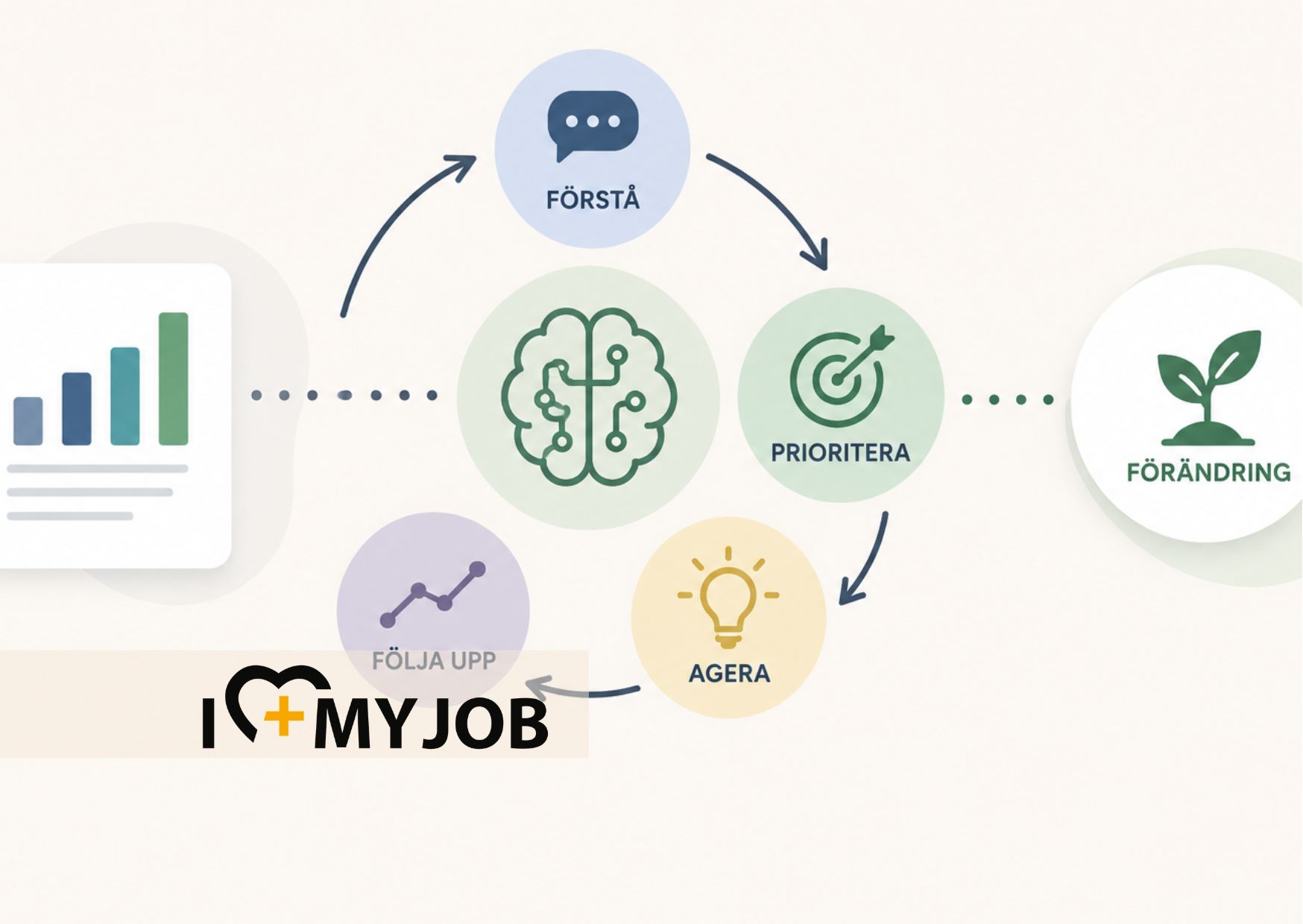
Listen → understand → prioritize → act → follow up → learn
The organization gathers feedback. AI helps the manager understand the results. The team discusses what matters most and decides what they want to work on. In the next survey, progress can be followed up.
Did what we did work?
Has the employee experience changed?
Should we continue on the same path, or do something differently going forward?
In this way, the employee survey becomes less of a report that arrives a few times a year and more of an active tool for continuous development.
Can AI solve managers’ biggest challenge?
Probably not on its own. AI can analyze large amounts of data, identify patterns, and help managers see what matters most. Solutions such as Puls+ AI can therefore shorten the path from results to the next step.
But understanding a result is one thing. Creating change is another.
Psychological safety, trust, and engagement are built through human relationships – through responsiveness, presence, and conversation. It means having the courage to address what isn’t working, listening to different perspectives, and showing employees that their feedback actually leads somewhere.
This is where the interplay between AI and human leadership becomes particularly interesting. AI can provide managers with better insights and guidance, while managers can spend more time and energy on dialogue with their teams and on driving change forward.
Perhaps, then, the most important question is not:
Can AI replace parts of a manager’s work?
But rather:
Can AI give managers better conditions to focus on what only humans can do?
That is where the real potential lies.
The employee survey of the future may therefore be less about collecting more data and more about making it easier to understand what the data is telling us, know what the next step should be, and actually do something with it.
Because real change can only happen when insights are turned into action.