AI is changing how organizations approach employee engagement and wellbeing. With the right tools, HR teams and managers can gain a faster understanding of how employees are doing, identify changes early, and get support in deciding what they can actually do to create a better workplace.
But not all AI platforms work in the same way.
When comparing different solutions, it is easy to focus on features: dashboards, pulse surveys, AI-powered analysis, reports, and automated recommendations.
But the most important question is actually a different one:
Does the platform help you turn insights into action?
Here are six things we believe are particularly important to consider when comparing AI platforms for employee engagement and wellbeing.
1. Make it easy for employees to have their voices heard
Good decisions start with good input.
To understand how an organization is really doing, employees need regular opportunities to share their experiences. At the same time, providing feedback should not become yet another task on their to-do list.
Long employee surveys once or twice a year can provide valuable insights, but a lot can change between surveys.
Short, recurring pulse surveys make it possible to track developments over time and identify changes earlier.
When comparing different platforms, consider:
- Is it quick and easy for employees to respond?
- Can you track developments continuously?
- Are the questions relevant and customizable?
- Can employees feel confident about how their responses are handled?
- Are response rates high enough to make the insights useful?
The easier it is to share feedback, the better equipped the organization is to understand what is really happening.
2. Does AI help you understand what is driving the results?
Knowing what is happening is important. Understanding why is even more important.
A traditional dashboard might show that engagement has declined or that workload has increased. But the next question is almost always the same:
What do we do about it?
This is where AI can create real value.
Instead of requiring HR teams and managers to analyze large amounts of data themselves, AI can help identify patterns, highlight relevant changes, and make the information easier to understand.
That does not mean AI should make the decisions.
Quite the opposite.
It should give HR teams and managers better information for decision-making, allowing them to spend less time interpreting numbers and more time on what actually makes a difference – dialogue, leadership, and development.
3. Does the platform support managers in their day-to-day work?
HR alone can rarely create meaningful change across an organization.
Much of the employee experience is shaped in everyday interactions – within the team and in the relationship between managers and employees.
That is why a good platform needs to do more than give HR an overview. It should also help managers understand and act on the results within their own teams.
For example, it can help managers:
- understand what their team’s results mean
- identify which areas should be prioritized
- receive concrete recommendations and suggestions for next steps
- initiate relevant conversations with their team
- track whether actions taken are actually making a difference
In this way, AI can support managers in their everyday work – without replacing human leadership.
That is an important distinction.
Technology should make it easier to be a good manager, not try to be the manager.
4. Does the platform provide a holistic view of wellbeing?
Engagement matters. But high engagement does not automatically mean that employees are doing well.
Someone can be engaged and motivated while simultaneously experiencing an excessive workload and insufficient recovery.
That is why it is important not only to measure how engaged employees are, but also to understand the factors that influence their wellbeing over time.
These may include workload, recovery, psychological safety, leadership, and workplace relationships.
Combining multiple perspectives makes it easier to see the bigger picture – and to identify signals before smaller challenges develop into larger problems.
At the same time, it is important to remember that AI should be used responsibly. The purpose should be to understand patterns and create better working conditions, not to diagnose or monitor individual employees.
5. Does the platform help you turn insights into action?
This may be the most important point of all.
Measuring is not the same as improving.
Many organizations already have large amounts of employee data. They may know which areas are working well and where the challenges lie.
The problem comes afterwards.
What do we do now?
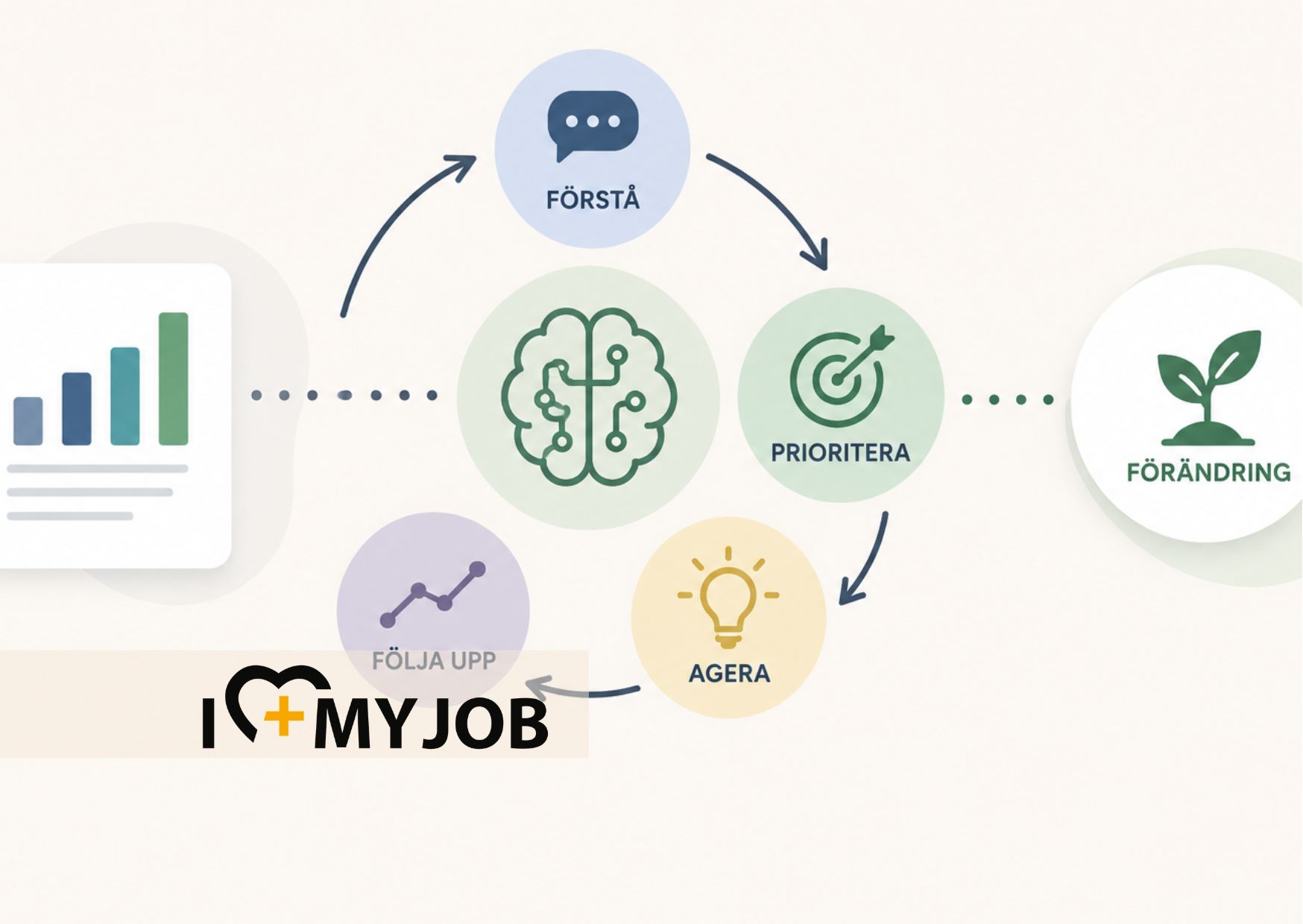
A good platform should support the organization throughout the entire process:
Listen → understand → prioritize → act → follow up.
If the results show, for example, that workload has become a challenge within a team, displaying a red indicator on a dashboard is not enough.
The manager needs to understand what the result means, receive guidance on which actions may be relevant, and be able to track progress after those actions have been implemented.
Only then does an employee survey become more than a measurement.
It becomes a tool for change.
6. Does the solution work across the entire organization?
For larger organizations, a platform needs to work effectively at multiple levels at the same time.
HR needs to see the bigger picture. Leadership needs to understand overall trends. Managers need relevant information about their teams. And employees need to feel confident sharing their experiences.
When evaluating different solutions, it is therefore important to look beyond the user experience itself.
Also consider:
- Can the solution scale across the entire organization?
- Does it work across different teams, countries, and languages?
- How are anonymity and access permissions managed?
- How does the provider approach GDPR compliance and information security?
- Can the solution integrate with your existing HR systems?
- How transparent is the platform about how AI uses and analyzes data?
For enterprise organizations, trust, security, and scalability are just as important as functionality.
AI is the tool – better workplaces are the goal
AI can make it significantly easier to collect feedback, identify patterns, and understand what is happening within an organization.
But the technology itself is not the goal.
The goal is to give HR teams, leaders, and managers better conditions for creating workplaces where people can thrive, develop, and perform sustainably over time.
So when comparing different AI platforms, do not just ask:
“What can the platform do?”
Instead, ask:
“What does it help our managers, employees, and HR teams do better?”
That is where the real difference lies.
From feedback to meaningful change
At Puls Solutions, we believe in making it easy to understand how an organization is doing – and even easier to do something about it.
Through continuous feedback, clear insights, and support for managers, organizations can move from simply measuring employee engagement and wellbeing to actively improving them.
Because when feedback leads to the right conversations and the right actions, small insights can create meaningful change
How do you build people and organizations that achieve world-class performance?
A webinar on September 24 at 9:00 AM with Magnus Helgesson, speaker and coach, and Christian Carlsson from Puls Solutions.