
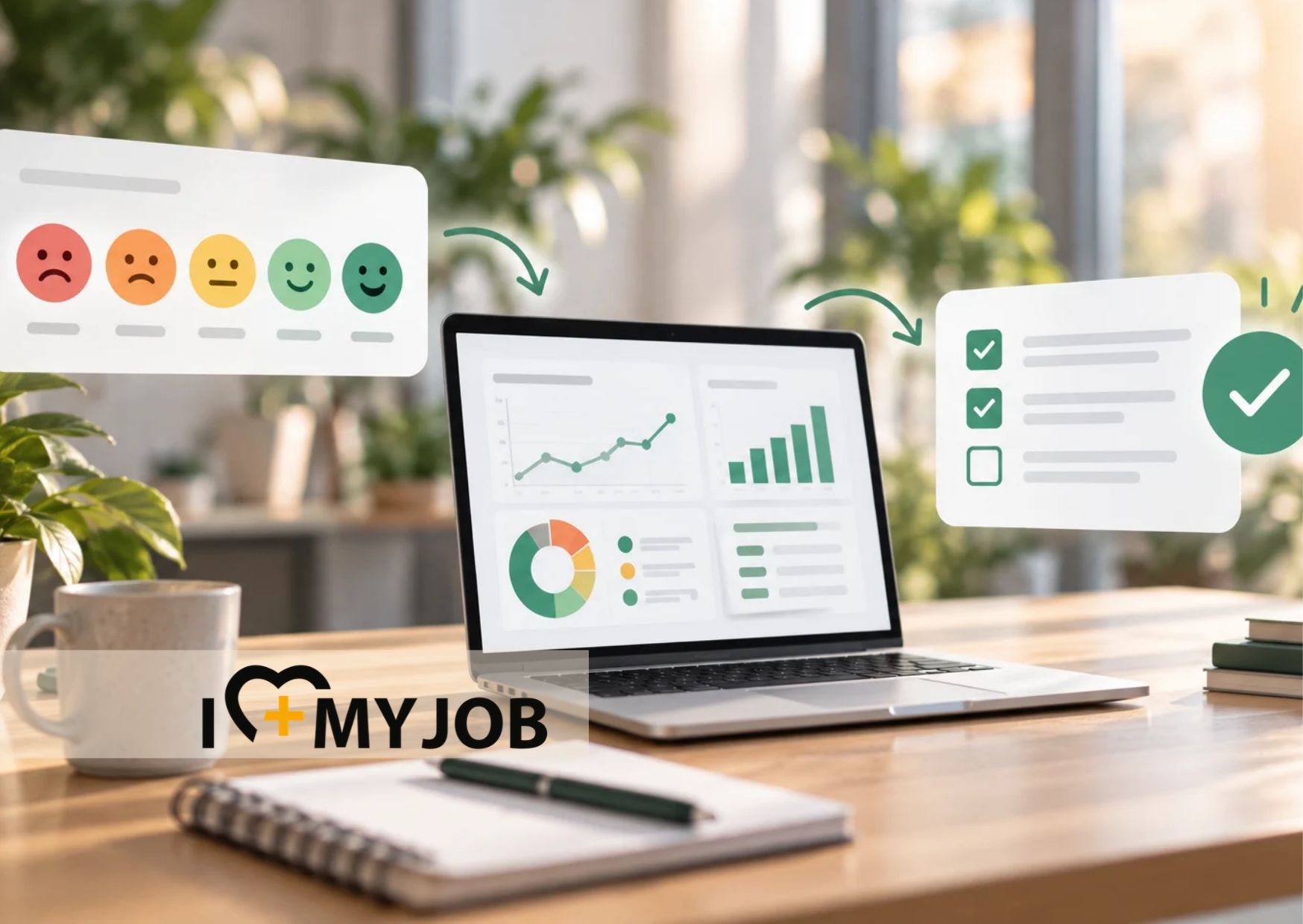
Understanding how employees are feeling is important. But what happens when the results from your pulse surveys come in? For HR teams and managers, a major part of the challenge lies in turning insights into concrete actions. This is where both the choice of pulse survey tool and the way you work with Actions play an important role.
More and more organizations are using continuous pulse surveys to gain a better understanding of employee engagement, well-being, and the work environment.
But collecting feedback is just the beginning. To drive long-term improvements, organizations also need to actively work with the results.
So, how do you choose a tool that not only helps you measure employee engagement but also creates the right conditions for meaningful change?
Why Isn’t the annual employee survey always enough?
A lot can happen in a year. Changes in workload, new ways of working, or communication challenges can affect both employee well-being and engagement long before the next employee survey takes place.
With continuous pulse surveys, organizations can track developments more frequently and identify changes at an earlier stage.
This creates better opportunities for ongoing dialogue between employees, managers, and HR.
But knowing how your employees are feeling isn’t enough. What truly matters is what you do with those insights.
5 things to consider when choosing a pulse survey tool
When HR managers and leaders compare different solutions, it’s easy to focus on features, reports, and statistics. But above all, a good tool needs to work seamlessly in the organization’s day-to-day operations.
Here are five key areas worth evaluating.
1. Easy to measure – Without survey fatigue
Pulsmätningar ska vara enkla att genomföra och besvara. Om undersökningarna upplevs som tidskrävande finns risken att deltagandet minskar.
Välj därför en lösning som gör det enkelt att samla in feedback och följa områden som engagemang, ledarskap, arbetsbelastning och trivsel.
2. Insights that help you understand the results
Knowing that employee engagement has declined is one thing. Understanding what might be causing it is another.
When comparing tools, it’s therefore important to explore how the results are presented and what options are available for tracking changes over time.
Because it’s only when the results are easy to understand that they can serve as a foundation for informed and relevant decisions.
3. From insights to action – With concrete recommendations
This brings us to one of the most important questions when choosing a pulse survey tool:
What happens after the results have been presented?
Imagine a pulse survey reveals that employees are experiencing high workloads or poor communication.
Identifying the challenge is the first step. The next step is to discuss what needs to change and which initiatives would be most effective.
This is where Actions – concrete steps and activities – can provide valuable support in driving improvements.
Examples of actions could include:
Reduce stress: Review priorities and workload distribution.
Improve communication: Introduce regular check-ins and provide clearer feedback.
Increase engagement: Encourage greater employee involvement in decision-making.
Develop leadership: Actively foster open dialogue, clarity, and trust.
By focusing on concrete actions, it becomes easier to turn employee feedback into practical initiatives that can be implemented in everyday work.
It’s also important to follow up on these initiatives and monitor how employees’ experiences change over time.
Because it’s not the number of surveys that creates a better workplace. It’s what you do with the results.
4. Building employee trust and confidence
For employees to feel comfortable sharing their experiences, they need to understand how their responses are handled.
Anonymity, transparency, and data protection are therefore important factors to consider when comparing different solutions.
Trust is also about employees feeling that their feedback is taken seriously and leads to meaningful dialogue.
5. A tool that works in everyday operations
An advanced tool isn’t necessarily the best one.
For pulse surveys to create real value, the results need to be easy to understand and actionable.
When evaluating a solution, consider whether it makes everyday work easier for both HR teams and managers, how much administration is required, and what support is available to drive continuous improvement.
The best tool is the one that helps your organization turn insights into action.
The biggest challenge Isn't measuring – It's creating change
Many organizations invest time and resources in conducting employee surveys. But the results alone don’t lead to improvements.
Creating meaningful change requires dialogue, clear priorities, and concrete actions.
By continuously working with pulse surveys and actions, HR teams and managers can establish a more structured approach to driving improvements.
Rather than simply focusing on how the organization is doing at a specific point in time, this makes it possible to continuously improve the work environment and employee engagement.
Puls+ – Turning insights into action
At Puls Solutions, we believe that employee feedback should lead to more than just statistics and reports.
It should create opportunities for better dialogue, stronger leadership, and a work environment where people feel valued, thrive, and grow.
With Puls+, we aim to make it easier for HR teams and managers to work with employee engagement and continuous improvement.
An important part of successful improvement efforts is not stopping at the results, but also taking concrete Actions and following up on the initiatives implemented.
Because when employee feedback is taken seriously and turned into action, it creates better conditions for long-term development.
A pulse survey helps you understand where your organization stands today. It’s the actions you take afterward that can drive real change.
What happens after your next pulse survey?
The next time you conduct an employee survey, take a moment to consider what happens when the results come in.
Will it become just another report to analyze? Or will it mark the beginning of meaningful improvements?
To create a workplace where people thrive and grow, organizations need to do more than just listen to their employees. They need to act on what they learn.
Curious about Puls+ and how it can help you take your pulse surveys and employee engagement efforts to the next level?
Get in touch with us at Puls Solutions – we’d love to tell you more.
Puls+ – Turning insights into action.
From a fresh start to Sweden’s Best Customer Service – When Culture Becomes Business Strategy
A webinar on October 21, from 9:00 to 9:45 AM, featuring Magnus Sahlin, CEO of Trelleborgs Energi, and Christian Carlsson from Puls Solutions.